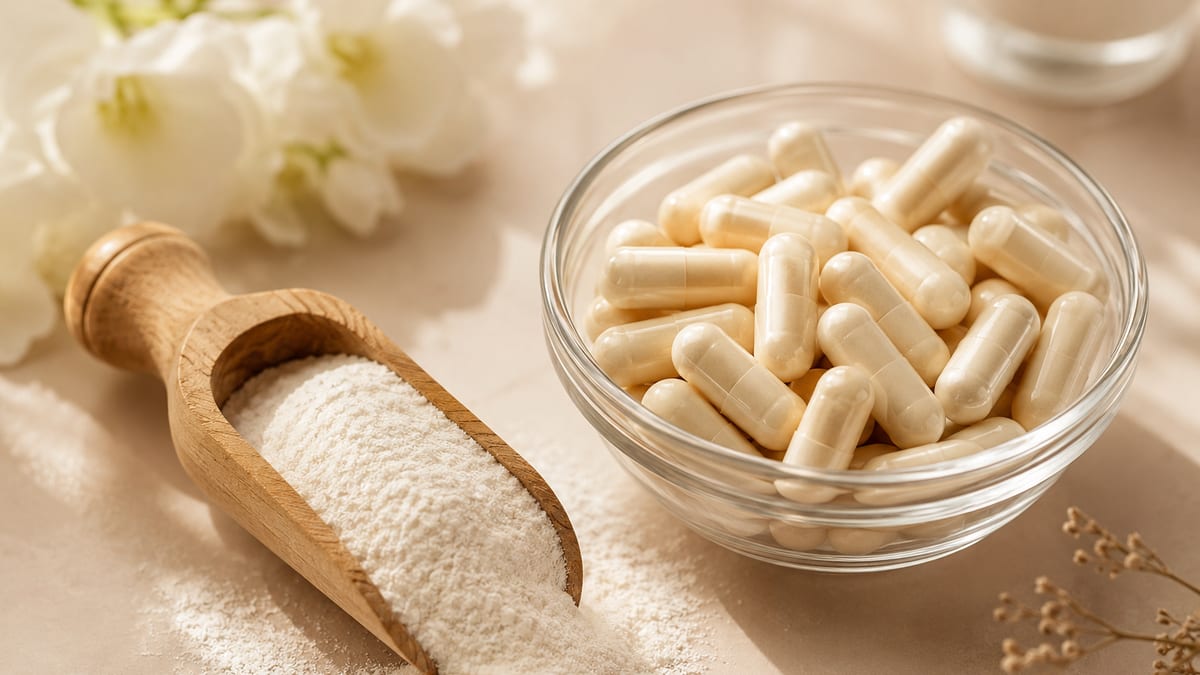
What Collagen Is and Why You Make Less of It With Age
Collagen is the protein that forms the body's "framework": skin, tendons, ligaments, cartilage, blood vessel walls and the bone matrix. A collagen molecule resembles a triple helix woven from the amino acids glycine, proline and hydroxyproline — and that structure is what gives tissues both strength and elasticity. In youth, skin fibroblasts actively synthesize new collagen, enough to keep tissues renewed. With age, synthesis slows: after 25 the body loses around 1% of its collagen per year, and in women the loss accelerates sharply in the first years after menopause as estrogen drops. Collagen is further broken down by UV light, smoking, excess sugar (glycation) and chronic stress. The result is visible in the mirror — skin loses density, wrinkles appear, joints feel "drier," and hair and nails become thinner.
What Collagen Is For: Four Main Jobs
Collagen does not work in one spot — it acts systemically, supporting several tissues where strength and elasticity matter. Here is what it is responsible for first and foremost:
- Skin, firmness and wrinkles — collagen builds the dermis and helps it hold moisture; at adequate levels skin is denser, fine lines are less visible and tone is better. This is the most common reason people take collagen for the skin.
- Joints and ligaments — cartilage is almost entirely type II collagen; supplements support mobility and comfort under load, which is why collagen is popular with people who train or face age-related joint "dryness."
- Hair and nails — collagen supplies amino acids for keratin and reinforces structure; over a course, hair and nails often become stronger and less brittle.
- Bones — about a third of bone tissue is a collagen framework that holds minerals in place; supporting collagen matters for bone density, especially in women after 45.
Collagen for Women: Why the Question Comes Up So Often
It is no accident that women are more interested in collagen: the drop in estrogen during perimenopause and menopause accelerates the loss of skin collagen — by some estimates up to 30% of dermal collagen is lost in the first five years after menopause. That is what drives the noticeable dryness, reduced firmness and more pronounced wrinkles in this period. So collagen for women is often part of a 35-plus beauty routine alongside vitamin C, omega-3 and enough protein in the diet. It is support, not an "elixir of youth": the supplement works together with nutrition, sleep, sun protection and not smoking.
Collagen Types: I, II and III — Which Is Which
The body has more than 25 types of collagen, but three matter in practice for supplements. Knowing what each type does helps you pick a product to match your goal:
- Type I — the most abundant (about 90% of the body's collagen). It is skin, bones, tendons and ligaments. This is the type chosen for skin, firmness, hair and nails. In supplements it usually comes from marine (fish) or bovine sources.
- Type II — the main collagen in cartilage. Its job is joints and mobility; native (undenatured) type II collagen is used in small doses specifically for the joints.
- Type III — works "in tandem" with type I in skin, blood vessels and internal organs, responsible for the elasticity and structure of youthful skin. In beauty complexes, types I and III usually appear together.
Hydrolyzed Collagen (Peptides) and Why It Absorbs
A whole collagen molecule is too large to be absorbed in the gut intact. That is why quality supplements use hydrolyzed collagen — it is pre-cut by enzymes into short peptide chains and individual amino acids. These peptides (often called collagen peptides) dissolve well, have little taste and absorb noticeably better than ordinary food gelatin. After you take them, the peptides break down into amino acids and small fragments that enter the bloodstream and serve as building material, while some of them act as a signal telling skin fibroblasts to synthesize more of your own collagen. Put simply, you give the body both the "bricks" and the cue to use them. Hydrolysate is also convenient in form: the powder mixes easily into water, a smoothie or coffee, and ready-made drinks and shots need no measuring.
How to Take Collagen: Dosage, Vitamin C and the Course
For a course to deliver, what matters is not only the collagen itself but consistency, dose and the "helpers" of absorption. Here are the benchmarks most studies and makers rely on:
- Dosage — for skin, hair and nails the usual target is 2.5–10 g of hydrolyzed collagen a day; for joints the upper part of the range is often used. Check the exact dose on the label of your specific product.
- With vitamin C — vitamin C is essential for synthesizing your own collagen, so collagen is often taken together with it; many beauty complexes already include vitamin C.
- As a course, not a one-off — a visible effect on skin and joints does not appear overnight: aim for a course of 8 to 12 weeks of daily use, then continue based on how you feel and with breaks.
- When to take it — there is no strict "only in the morning on an empty stomach" rule; collagen is absorbed throughout the day regardless of meals. A morning dose on an empty stomach is handy as a habit, but you can also take it with food without losing any benefit.
- Extra cofactors — collagen synthesis is helped by zinc, copper, silicon and enough protein in the diet; there should be no serious deficiencies, or the supplement has nothing to build tissue from.
From What Age and Who Should Take It
There is no universal "starting age," but there are sensible guideposts. Before 25 the body usually keeps up with synthesis on its own, and the priority is nutrition, sleep and sun protection rather than jars. After 25–30, when production starts to decline, collagen makes sense as preventive support for skin and joints. It is considered separately for: women in the 35-plus period and in menopause; people who train hard and load their joints; those recovering after intense exertion; and cases of noticeable skin dryness or brittle hair and nails. Who should be more cautious and check with a doctor first: pregnant and breastfeeding women, people allergic to the collagen source (fish, beef), and those with chronic conditions or on medication. Collagen is support, not a replacement for treatment.
Diet Plus Supplements: Collagen Works in Tandem
A supplement does not replace your diet — it complements it. The body builds its own collagen from the amino acids it gets from protein-rich food, so the foundation is enough protein and the cofactor micronutrients. What supports collagen levels besides supplements:
- Dietary protein — meat, fish, eggs and legumes supply glycine and proline for synthesis; bone broths are a natural source of collagen amino acids.
- Vitamin C — citrus, bell peppers, kiwi and berries; without it collagen synthesis is impossible.
- Zinc, copper, silicon — nuts, seeds, whole grains and seafood support the enzymes of synthesis.
- Protection from breakdown — sun protection, not smoking and controlling sugar slow glycation and collagen loss.
- A supplement as a booster — hydrolyzed collagen or a beauty complex with vitamin C covers the higher demand when diet alone is no longer enough (age, training load, menopause).
Collagen in the Greenway Catalog: Where to Look
In the Greenway catalog, collagen and beauty support are easy to find by brand. For basic products with collagen and vitamin C, plus complexes for skin, hair and nails, look at the Welllab range — the dependable "classics" for daily support. Premium beauty complexes for specific goals are in the BeverOne range. The easiest way to start is from the goal-based catalog sections — Supplements, Beauty, Face care — and then compare the details inside: collagen type, the hydrolysate dose per serving, and whether vitamin C and cofactors are included. You can place an order on the official Greenway website via the link in the product card; buying through the partner catalog usually comes with a discount of 20% or more compared with retail.