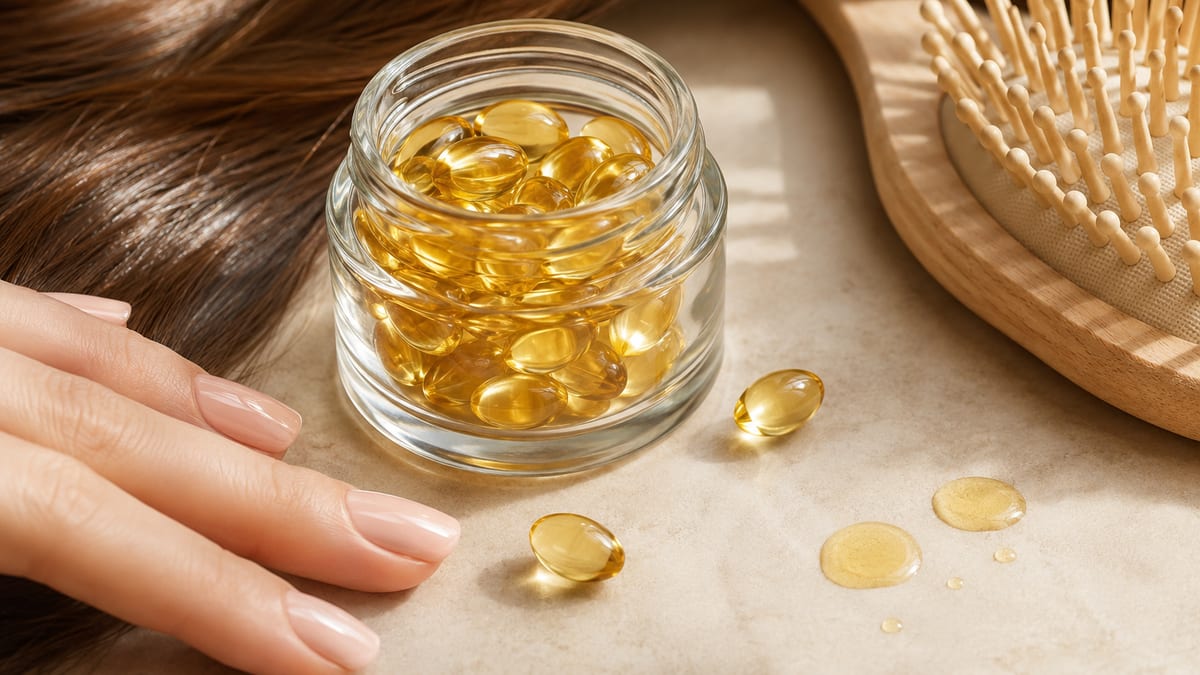
What Hair and Nails Are Actually Made Of
To understand which vitamins you need, it helps to know that hair and nails are mostly the protein keratin. Hair is roughly 80–90% keratin, and the nail plate is made of densely packed keratin layers too. That means without enough protein and amino acids in your diet, the body simply has nothing to build strong hair and dense nails from. Then the "assemblers" and "suppliers" come into play: B vitamins take part in keratin synthesis, zinc and iron are needed for follicle cell division, vitamin D wakes new hair growth from "dormant" follicles, and omega-3 fatty acids hold in moisture and elasticity. So it is a chain: protein is the building material, while vitamins and minerals are the tools, without which construction stalls. That is why a single "magic pill" rarely fixes everything — the complex and your diet both matter.
Key Nutrients for Hair and Nails
This is not the full list, but these are the substances most often linked to the condition of hair and nails — and the ones whose deficiency causes visible problems. Briefly, what each one does:
- Biotin (vitamin B7, H) — involved in keratin synthesis; a shortage can cause brittle nails and thinning hair. The most hyped ingredient in beauty complexes, although a real deficiency is rarer than people think.
- Zinc — needed for hair follicle cell division and nail growth; a deficiency shows up as hair loss and white spots or ridges on the nails.
- Iron — carries oxygen to the hair roots; a shortage (especially in women) is a common hidden cause of diffuse shedding. It is checked via ferritin in a blood test.
- Vitamin D — regulates the follicle life cycle; low levels are linked to shedding and slowed growth. Deficiency is widespread, especially in winter.
- Omega-3 — fatty acids support scalp hydration and hair shine, reducing dryness and brittleness.
- Protein and collagen — amino acids for keratin; collagen supplies glycine and proline and supports the scalp and nail matrix.
- Vitamins A, E, C — A regulates the sebaceous glands, E and C act as antioxidants and aid collagen synthesis; C also improves iron absorption.
- Silicon (silica) — linked to nail and hair strength; often included in specialized beauty formulas.
- B group (B5, B6, B9, B12) — the general "energy" and metabolic backdrop for growth; folate and B12 matter for cell division.
Biotin and Collagen: What Is Worth Understanding
Biotin and collagen are the two most popular ingredients in beauty complexes, and they carry the most myths. Biotin (B7) really is needed for keratin synthesis, but an actual deficiency is uncommon — it occurs with certain diets, absorption disorders or some medications. If you are not deficient, "mega-doses" of biotin will not make hair thicker, but they can skew blood test results (for example, thyroid hormones) — something worth flagging to your doctor. Collagen is not a "vitamin" but a protein: it supplies amino acids for keratin and supports the scalp and nail matrix. It works best not on its own but together with vitamin C, which is needed to synthesize your own collagen. The takeaway is simple: biotin and collagen are useful building blocks, but they do not replace iron, zinc, vitamin D and adequate protein in the diet.
Signs Your Hair and Nails Are Short on Something
The body usually sends signals in advance. This is not a diagnosis but a reason to look closer at your diet and, if needed, get tested. What to watch for:
- Increased shedding — noticeably more hair on the pillow, in the bath and on the brush; up to 100 hairs a day is normal, consistently more is a concern.
- Thinning and loss of volume — hair has become finer, holds styling worse, and the scalp shows through.
- Brittleness and dryness — hair snaps along its length, ends split, and shine is lost.
- Splitting nails — the plate peels into layers, breaks at the edge and grows slowly.
- White spots, ridges or dents on nails — often linked to a zinc or iron deficiency.
- Fragile, soft nails — they bend and break under everyday tasks.
- Dry scalp, dandruff, itching — can point to a shortage of omega-3 and vitamins A and E.
Why Deficiencies Happen: The Main Causes
More often than not the problem is not "bad genetics" but lifestyle and temporary states. Understanding the cause helps you choose the right support rather than guessing at the symptom:
- Unbalanced diets — strict restrictions, unmanaged vegetarianism, a calorie and protein deficit quickly hit hair and nails: there is simply nothing to build them from.
- Stress and poor sleep — chronic stress pushes some follicles into the shedding phase (telogen effluvium), which shows up 2–3 months after the stressful event.
- Hormonal changes — pregnancy, the postpartum period, menopause and thyroid problems noticeably change hair and nail growth.
- Season and lack of sun — vitamin D drops in winter, and seasonal shedding often increases in autumn.
- Hidden iron deficiency — especially in women with heavy periods; fatigue and shedding frequently go together.
- Aggressive care — frequent coloring, heat styling and gel polish without breaks thin and weaken the structure.
- Age and declining collagen synthesis — after 25–30 collagen production falls, so the scalp and nail matrix get less support.
How to Choose a Complex and How Long to Wait
The biggest mistake is expecting results in a week and quitting. Hair grows slowly, so changes are not immediate. Here are the guidelines that help you choose a product and avoid disappointment:
- Formula matters more than a loud name — make sure the complex has not just biotin but also zinc, iron (or separately based on tests), vitamin D, the B group and vitamin C for absorption.
- Match it to your goal — for brittle nails focus on zinc, silicon and protein; for shedding, iron, vitamin D and zinc; for dryness and shine, omega-3 and vitamins A and E.
- A course of at least 3 months — the hair growth cycle is long and new healthy hair emerges gradually; first results are usually visible at 8–12 weeks, lasting ones by 3–6 months.
- Realistic doses — "mega-dose" formulas are not automatically better; go by daily values and the label, and check with a doctor if in doubt.
- Cause first, supplement second — with heavy or patchy shedding, test ferritin, vitamin D and TSH: a supplement will not replace treatment if the issue is iron deficiency or the thyroid.
- Consistency — missed days undo the course; the effect comes from taking it daily, not "when you remember."
Diet Plus Care: Supplements Work as a Team
Vitamins are a booster, not a substitute for a proper diet and gentle care. Without protein and basic nutrients from food, even a good complex works at half power. What supports hair and nails besides supplements:
- Enough protein — meat, fish, eggs, legumes and cottage cheese supply amino acids for keratin; this is the foundation of strong hair and nails.
- Iron and zinc sources — red meat, liver, seafood, pumpkin seeds and legumes; plant iron absorbs better with vitamin C.
- Healthy fats — oily fish, flaxseed oil and nuts provide omega-3 for elasticity and shine.
- Vegetables and berries — vitamins C, A, E and antioxidants protect follicles and aid collagen synthesis.
- Gentle care — less heat styling and harsh chemistry, mild shampoos, breaks for nails from gel polish, and protection from over-drying.
- A supplement as support — a complex with biotin, zinc, vitamin D and collagen covers the higher demand when diet and care alone are not enough (stress, season, recovery).
Vitamins for Hair and Nails in the Greenway Catalog: Where to Look
In the Greenway catalog, beauty vitamins and nutrients for hair and nails are easy to find by section and brand. Basic complexes with biotin, collagen, zinc and B vitamins are in the Welllab range — a reliable "classic" for everyday support. It is easier to start from the goal-based sections — "Vitamins & minerals," "Supplements," "Hair care" — and then compare formulas inside: which nutrients are included, whether there is zinc, iron, vitamin D and vitamin C for absorption, and what form of collagen is used. You can place an order on the official Greenway website via the link in the product card; buying through the partner catalog usually comes with a discount of 20% or more off retail. Remember: a complex is support, and with pronounced shedding you should see a doctor first.