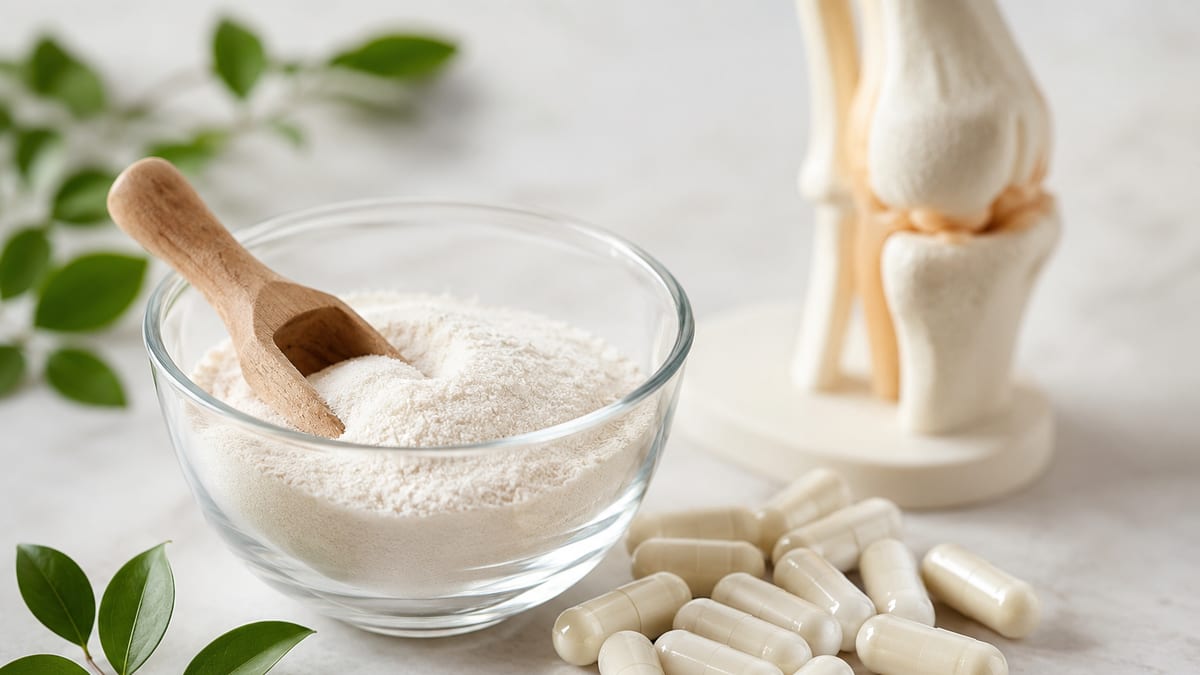
How collagen relates to cartilage, ligaments and tendons
A joint is more than just bones. Between them sits cartilage, which works as a shock absorber and a gliding surface, while ligaments and tendons hold the structure together. All of these tissues are built mainly from collagen: articular cartilage is almost 60% collagen type II by dry weight, while ligaments and tendons are dense type I collagen. Collagen fibers give tissues tensile strength and, at the same time, the elasticity to dampen impact loads. With age and under intense training, collagen turnover in these tissues slows, cartilage thins and loses water, and ligaments become less elastic. That is exactly why the idea of "giving the body building material and a signal to synthesize" via collagen supplements sounds logical for joints, not only for skin.
Type II versus I and III: which collagen for joints
For joints what matters is not "collagen in general" but the specific type — this is the key point when choosing a product:
- Type II is the main cartilage collagen. Joint supplements use two formats: hydrolyzed type II collagen in gram doses as building material, and undenatured (native) UC-II collagen in very small doses (around 40 mg), which works differently — through immune regulation of inflammation in the joint.
- Type I is the basis of ligaments, tendons and the bone matrix. Type I hydrolysate is taken when the goal is to support the ligament apparatus and tendons under load, not just cartilage.
- Type III pairs with type I in connective tissue and vessels; it is not usually singled out for joints, but it is often present alongside type I in general hydrolysates.
- Practical takeaway — for all-round joint support people usually take a hydrolysate (types I and II) as a course, while native UC-II is treated as a separate, targeted product per its instructions. Do not confuse the doses: 40 mg of UC-II and 10 g of hydrolysate are different approaches, not "too little / too much."
Does collagen help joints: the honest read on the data
Sobriety matters here. Some studies show that a course of collagen peptides and native type II collagen may reduce joint discomfort and improve load tolerance in athletes and people with age-related changes. But the effect is moderate, cumulative and individual: this is not a painkiller and not a way to "regrow" worn cartilage. Collagen does not dissolve deposits, does not realign joints and does not reverse osteoarthritis. The realistic benefit is support for comfort and mobility alongside adequate load, not miraculous repair. If someone promises you "new cartilage in one course," that is marketing, not science. The supplement makes sense as part of a strategy together with sensible training, weight control and nutrition, and only when there is no acute joint problem that needs a doctor.
When collagen will not help and you need a doctor
Collagen is about support, not treatment, and there are situations where the supplement is useless or even dangerous as a replacement for care. See a doctor (orthopedist, rheumatologist) if: the joint hurts at rest or at night; there is swelling, redness or local heat; a knee or shoulder "locks," gets blocked or loses range; pain appeared after an injury; morning stiffness lasts longer than 30 minutes (a possible sign of inflammatory arthritis). Osteoarthritis, arthritis, meniscus or ligament damage are treated not with supplements but as prescribed by a specialist. In such cases collagen can be discussed with your doctor as adjunct support, but it does not replace diagnosis and therapy.
Who really needs collagen for joints
There is no universal "everyone over 30." There are groups for whom collagen joint support is more justified:
- Sport and strength loads — running, CrossFit, weightlifting and combat sports place repeated stress on cartilage, ligaments and tendons; collagen is considered part of recovery.
- Age 40-plus — your own synthesis has been declining for years, and "dryness" and painless creaking appear; here collagen is used as preventive support for mobility.
- High everyday and occupational loads — standing work, heavy physical labor and excess weight increase the load on knees and lower back.
- Creaking and discomfort without a diagnosis — painless creaking and a feeling of being "un-lubricated" is often linked to age-related changes; if there is no pain, collagen is reasonable as support (but the onset of pain is a reason to see a doctor).
- Recovery after intense periods — training camps, marathons or a high-load season, when tissues need more building material than the usual diet provides.
How to take collagen for joints: dose, vitamin C, course
For a course to make sense, regularity, an adequate dose and absorption cofactors matter. The benchmarks manufacturers and studies rely on:
- Hydrolysate dosage — for joints people usually aim at the upper part of the range, around 10 g of collagen peptides a day; for native UC-II the scheme is entirely different — about 40 mg a day per the label. Check the exact dose on the specific product.
- Vitamin C is essential — without it your body cannot synthesize collagen; take collagen together with vitamin C or choose a complex that already includes it.
- A course, not a one-off — the joint effect is cumulative: aim for a course of 8 to 12 weeks of daily intake, then assess how you feel and repeat with breaks if needed.
- When to take it — there is no strict rule; collagen is absorbed throughout the day regardless of meals, so it is convenient to tie intake to a habit (morning or after training), which does not change the benefit.
- Synthesis cofactors — zinc, copper, silicon, magnesium and enough protein in the diet are needed so the body has both the material and the tools to build joint tissue.
Collagen, glucosamine and chondroitin: combine or not
Glucosamine and chondroitin are not collagen but other components of the cartilage matrix (glycosaminoglycans) traditionally used to support joints. They work through a different mechanism and do not conflict with collagen, so they are often combined: collagen provides the protein scaffold, while glucosamine and chondroitin support the intercellular substance and water retention in cartilage. Often all of this is already assembled in a single joint complex along with vitamin C, MSM (methylsulfonylmethane) or hyaluronic acid. If you take separate products, follow the label doses and do not double up the same components from different jars. Important: none of these supplements treats osteoarthritis — it is support, and the regimen for a diagnosed condition is set by a doctor.
Nutrition plus supplements and where to find collagen in the catalog
A supplement does not replace your diet — it complements it. The base for joints remains enough protein (the source of amino acids for collagen), vitamin C, cofactors, and control of load and weight. What supports joints beyond the jars and where to find products:
- Protein and amino acids — meat, fish, eggs, legumes and bone broths supply glycine and proline for collagen synthesis.
- Vitamin C and micronutrients — citrus, peppers, kiwi and berries, plus zinc, copper and silicon from nuts, seeds and whole grains.
- Load and weight control — sensible progression in sport, a proper warm-up and a normal weight reduce cartilage wear more than any supplement.
- Where to look in the catalog — basic hydrolyzed collagen and joint complexes with vitamin C are easy to find in the Welllab line, and premium products for specific goals in the BeverOne line. Start with the Supplements and Vitamins & minerals sections, then compare the collagen type, the hydrolysate dose per serving and the presence of cofactors.
- Buying — you can place an order on the official Greenway website via the link in the product card; buying through the partner catalog usually comes with a discount of 20% or more versus retail.