Why limescale forms and why it is harmful
Limescale is a hard chalky deposit that appears when hard water is heated. Tap water has dissolved calcium and magnesium salts; the more of them, the harder the water. When heated, these salts precipitate and settle as a dense crust on heating elements, kettle walls, hoses and heaters. The higher the temperature and the more often you heat, the faster the layer grows. The harm of limescale is not just an ugly coating.
- Wasted energy. A scale layer of a couple of millimetres acts as insulation: the heater works longer, and your electricity and water bills rise. The appliance effectively runs idle part of the time.
- Appliance breakdowns. Scale on the heater leads to overheating and failure of the element — the single most common cause of repairs for washing machines, dishwashers, kettles and water heaters.
- Worse results. In a washing machine scale makes laundry stiff and grey, in a dishwasher it leaves streaks on dishes, in an iron it leaves rusty marks on fabric, in a kettle it leaves flakes in the water and an off taste.
- Clogs and leaks. Limescale builds up in hoses, nozzles and on the tap, narrows the passage, lowers the pressure and over time triggers leaks.
How to remove limescale from a kettle
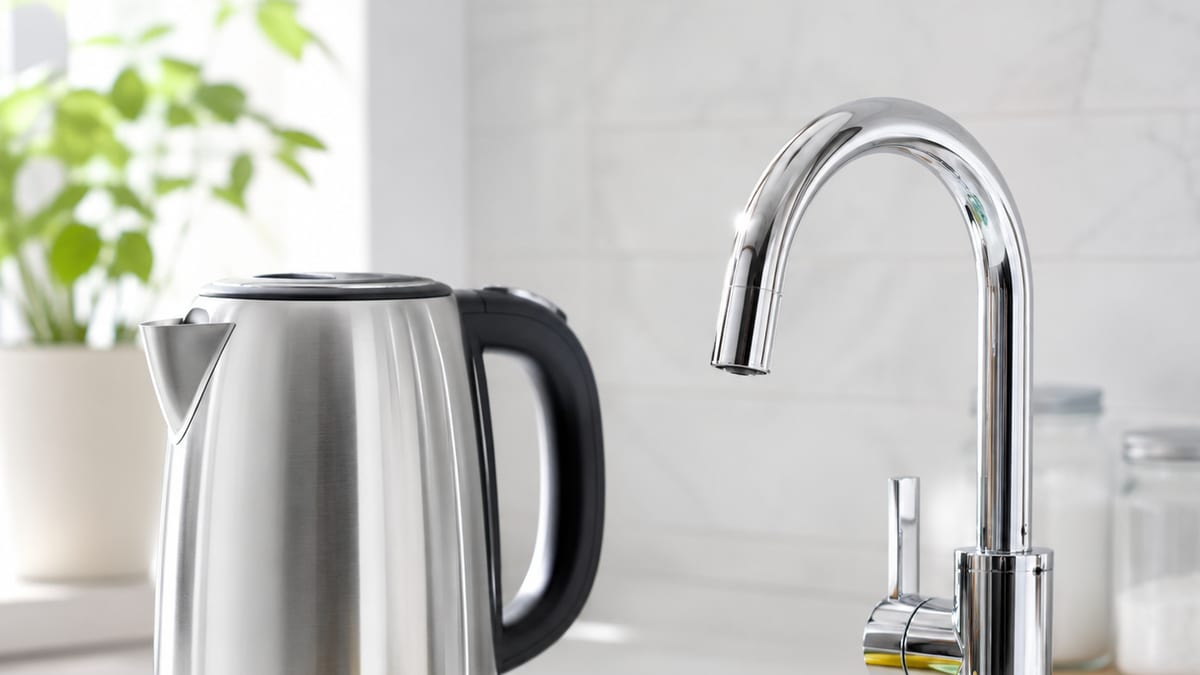
The kettle suffers from limescale first, because its water is boiled several times a day. Removing the scale is the easiest of all — with both home remedies and dedicated products. Every method ends with a mandatory rinse and a control boil of clean water.
- Citric acid. Add 1-2 tablespoons (15-20 g) to a full kettle of water, bring it to a boil and leave for 30-60 minutes. The acid dissolves the chalky deposit, after which you pour out the solution and wipe off the residue with a soft sponge.
- Vinegar. Pour in a solution of about 1 part white vinegar to 3 parts water, boil it and let it stand for 30 minutes. The method is effective but leaves an odor — afterwards you will need a thorough rinse and airing.
- A dedicated descaler. A ready descaler works faster and is gentler on the material: follow the dosage on the pack, usually a single heat-and-soak cycle is enough.
- Final rinse. After any product, boil clean water 1-2 times and pour it out to remove leftover acid and taste. Only then is the kettle ready to use.
How to remove limescale from a washing machine
In a washing machine limescale settles on the heater and in the drum, especially if you often wash at high temperature. Cleaning is done empty — with no laundry. Home remedies work, but for heavy scale a dedicated washing machine cleaner is more reliable.
- With citric acid. Add 60-100 g of citric acid straight into the drum or the detergent drawer and run a long cycle at 60-90 °C with no laundry. The acid will dissolve the scale on the heater and the tub walls.
- With a dedicated product. Pour in a washing machine descaler as directed and run the recommended cycle. Such products are gentler on the rubber seals than concentrated acid.
- Caring for the seal and drawer. Take out and rinse the detergent drawer, wipe the rubber door seal — that is where scale, mold and product residue collect. A fine microfiber cloth makes this easy.
- Regularity. Do a preventive descaling once every 1-3 months depending on water hardness — it is cheaper than replacing the heating element.
How to remove limescale from a dishwasher
A dishwasher also heats water, so limescale settles on the heater, the spray arms and the chamber walls. The signs are a white coating on dishes and walls, streaks and cloudy glass. Cleaning is done with an empty machine, no dishes inside.
- With citric acid. Add 100-150 g of citric acid into the dispenser or the bottom of the chamber and run the hottest cycle with no dishes. The acid will lift scale off the heater and the nozzles.
- With a dedicated cleaner. Pour in or place a dishwasher cleaner as directed and run the recommended program — it dissolves both limescale and grease deposits.
- Cleaning the filter and nozzles. Take out and rinse the drain filter and clear the spray arm holes with a toothpick — limescale often clogs exactly these and worsens the wash.
- Salt and regularity. Regularly top up dishwasher salt (it softens water through the ion exchanger) and clean once every 1-2 months so scale does not accumulate.
How to clean an iron and a tap from limescale
An iron and taps suffer from limescale differently, but the fix is similar. In an iron the scale clogs the steam holes and stains fabric; on a tap or shower head limescale lowers the pressure and ruins the look.
- Iron — self-clean function. Fill with water, heat the iron to maximum, switch it off and press the self-clean button over the sink — steam and water push the scale out of the holes. Repeat 1-2 times.
- Iron — citric acid. If there is no self-clean, pour a weak citric acid solution into the tank, heat it, let it stand and blast steam over the sink, then rinse with clean water. Avoid vinegar in an iron — the sharp odor and the risk to the parts are not worth it.
- Iron soleplate. Remove limescale marks from the soleplate with a damp microfiber cloth and a mild product on a cold iron, without scratching the coating with abrasives.
- Tap and shower head. Soak a cloth in a citric acid or vinegar solution, wrap the problem area for 30-60 minutes, then rinse and wipe. The tap aerator and the shower head can be unscrewed and soaked whole.
Home remedies vs dedicated descalers: what to choose
The main question is whether to use citric acid and vinegar or a ready descaler. Each option has its niche, and the right choice depends on the appliance and the degree of scale.
- Citric acid. Cheap, odorless, safer than vinegar and suitable for almost everything: kettle, washing machine, dishwasher, iron. The best choice for regular prevention.
- Vinegar. Effective and accessible, but it gives off a sharp odor and with frequent use can harm rubber seals and aluminium. Handy for soaking a tap and shower head, but not the best option for an iron and rubber parts.
- Dedicated descalers. They work faster and are often gentler on appliances, containing inhibitors that protect the parts. They are justified for heavy old scale and for expensive appliances you do not want to risk.
- What not to do. Do not use harsh abrasives and metal brushes — they scratch enamel and coatings. Do not mix different products together and do not exceed the acid dosage, especially in appliances with rubber.
Limescale prevention: filters, softening, regularity
Removing limescale is half the job; it is far cheaper not to let it form. Prevention is built around water hardness: the harder the water, the more actively you need to act.
- Filters and water softeners. A filter jug or an inline filter lowers hardness, and a whole-house softener protects all the appliances in the home at once. This is the most systematic way to fight limescale.
- Softening additives. In the washing machine and dishwasher use dedicated salt and water-softening products — they bind calcium and magnesium salts before they settle.
- Less overheating. Do not boil a kettle "in reserve" many times over, and wash at a sensible temperature — the rarer the strong heating, the slower the scale grows.
- Regularity. A light preventive cleaning once every 1-2 months removes thin scale in a single cycle, whereas an old crust has to be removed slowly and aggressively.
- Dryness after use. Wipe the kettle, tap and washing machine seal dry — scale and mold form more slowly on a dry surface. It helps to keep a microfiber cloth nearby.
What is safer for appliances and health: eco care
The harsher the product, the higher the risk both for the appliance parts and for your health: concentrated acids and caustic chemicals irritate skin and breathing, leave marks and damage seals. So for regular prevention it makes more sense to rely on mild products and the mechanics of microfiber, and to keep heavy chemistry for rare neglected cases. Fine microfiber grabs scale, moisture and streaks with almost no product — that is how the Green Fiber line from Greenway is built: cloths and wipes for the tap, the iron soleplate, the machine seal and glass surfaces. AquaMagic eco products work on the "clean with water" principle and suit anywhere you do not want extra harsh chemistry near dishes, laundry and children. For the limescale itself the basis stays the same — citric acid and regularity, while surface care is handled by the eco kit. You can pick products and microfiber on the official Greenway website, and ordering through the partner program gives a discount of 20% or more on the whole range.